What Is Antisocial Meaning, Behavior, and ASPD Explained
"Antisocial" is one of those words that sounds simple until you try to use it carefully. In everyday conversation, people may use it to mean quiet, shy, private, rude, rebellious, or harmful. In psychology, however, antisocial usually points to behavior that disregards other people's rights, safety, boundaries, or basic social rules. That difference matters. A person who enjoys solitude is not automatically antisocial, and one selfish or impulsive moment does not define someone's personality. If you are trying to understand a pattern in yourself or someone close to you, a private self-reflection starting point can help you organize your questions.

What Does Antisocial Mean?
The clearest antisocial meaning is "against social wellbeing," not simply "less social." Antisocial behavior is behavior that violates important social expectations because it harms, exploits, intimidates, deceives, or repeatedly disregards other people. The term can describe a single behavior, a recurring pattern, or, in a clinical context, traits associated with antisocial personality disorder.
That does not mean every unpopular, awkward, blunt, or rule-breaking action belongs in the same category. Context matters. A teenager talking back once, an adult canceling plans, or someone preferring a quiet weekend is not the same as a long-running pattern of lying, aggression, theft, reckless disregard for safety, or lack of remorse after harming others.
A useful way to read the word is to ask two questions: Is there a repeated disregard for other people's rights or safety? And is the behavior causing harm, fear, exploitation, legal problems, or serious relationship damage? If both answers are yes, the word "antisocial" is being used closer to its psychological meaning.
Antisocial Behavior Meaning in Everyday Life
Antisocial behavior can show up in different degrees. At the mild end, it may look like chronic hostility, repeated boundary violations, intimidation, or a habit of blaming others after causing harm. At the severe end, it may include violence, theft, fraud, stalking, coercion, or repeated illegal behavior.
People often search "what is antisocial behavior in psychology" because they want a clean definition. In psychology, antisocial behavior usually refers to actions that conflict with the rights of others or with major social norms. This can include deceitfulness, exploitation, impulsivity, aggression, irresponsible behavior, and indifference after hurting someone. Those behaviors become more concerning when they are persistent, happen across settings, and continue despite consequences.
It helps to separate behavior from identity. Calling a behavior antisocial can be accurate and useful. Calling a person "an antisocial" is usually less helpful because it turns a pattern into a fixed label. A more careful question is: "What pattern is happening, how often does it happen, and who is being affected?"
Antisocial vs Asocial vs Introverted
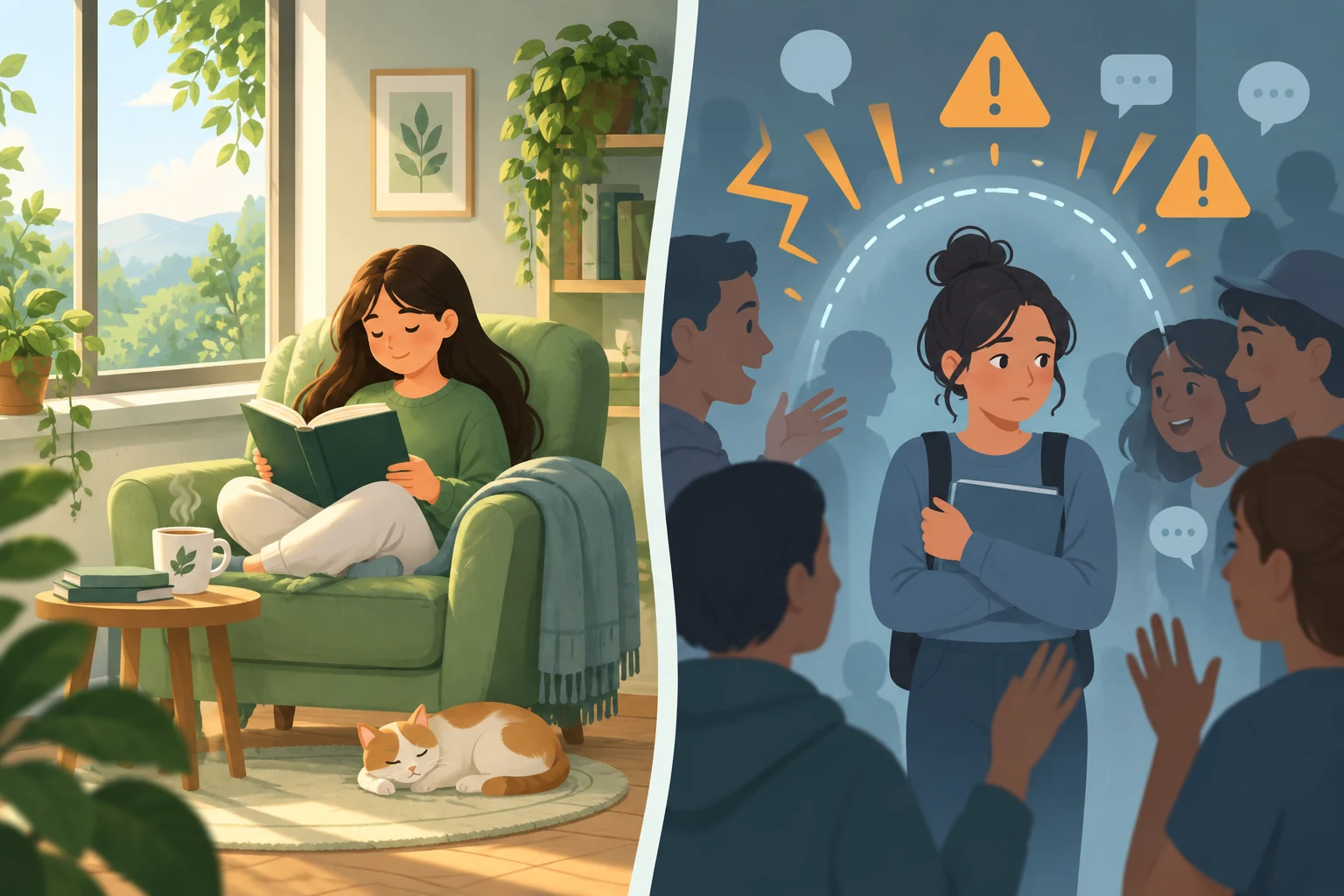
Antisocial vs asocial is one of the most important distinctions. Asocial means a person prefers limited social contact or feels little motivation to socialize. Introverted means a person tends to recharge through solitude and may prefer smaller, quieter interactions. Neither term automatically implies cruelty, exploitation, lawbreaking, or disregard for others.
Antisocial behavior is different because the central issue is impact on other people. Someone can be highly social and still behave antisocially if they use charm to manipulate, deceive, exploit, or intimidate. Someone can also be very private and not be antisocial at all if they respect other people's boundaries and rights.
Here is a practical comparison:
| Term | Core idea | Usually harmful to others? | Example |
|---|---|---|---|
| Introverted | Recharges alone | No | Prefers a quiet evening after work |
| Asocial | Low desire to socialize | Not by itself | Avoids parties but treats people respectfully |
| Antisocial | Disregards rights or norms | Often, especially when repeated | Lies, threatens, steals, exploits, or acts recklessly |
This distinction is especially important for shy people. Shyness can involve anxiety, self-consciousness, or fear of judgment. It does not mean the person lacks empathy or wants to harm others.
What Is an Antisocial Person?
People usually ask "what is antisocial person" when they are trying to make sense of a repeated pattern. A careful answer is that an antisocial person, in everyday language, is someone who often acts against the rights, safety, or wellbeing of others. They may seem indifferent to the damage their actions cause, especially when the behavior benefits them.
Possible patterns include repeated lying, manipulation, intimidation, impulsive risk-taking, aggression, disregard for rules, chronic irresponsibility, and little visible remorse. These signs are more meaningful when they occur together over time, rather than as isolated incidents.
Still, online reading cannot tell you what is happening inside another person's mind. Trauma, substance use, mood disorders, stress, learned survival strategies, and situational pressures can all affect behavior. A pattern may be serious without fitting a neat label. That is why it is better to describe observable actions than to jump straight to a personality label.
If the question is about yourself, look for patterns rather than one bad day. Do you repeatedly violate boundaries even after people explain the impact? Do you often lie to avoid responsibility or gain advantage? Do you feel little concern when your choices harm someone? Honest reflection can be uncomfortable, but it can also be useful.
What Is Antisocial Personality Disorder?
Antisocial personality disorder, often shortened to ASPD, is a clinical personality disorder associated with a persistent pattern of disregarding and violating the rights of others. It is not the same as being shy, private, blunt, emotionally reserved, or socially awkward.
Commonly discussed ASPD-related traits include deceitfulness, impulsivity, aggression, reckless disregard for safety, repeated irresponsibility, and lack of remorse after harming or mistreating others. ASPD is generally discussed as an adult condition, with a history of serious conduct problems before adulthood often being part of professional assessment.
The phrase "antisocial disorder" is often used by searchers, but "antisocial personality disorder" is the more precise term. It is also related to, but not identical with, popular words like "sociopath." Sociopath is not the formal clinical term, but many people use it when they are trying to describe ASPD-related traits in plain language.
For people exploring these questions, an ASPD traits screening experience can offer structured self-reflection. It should not be treated as a clinical assessment, and it cannot replace a licensed professional's evaluation.
Examples of Antisocial Behavior
Examples are useful because "antisocial" can otherwise feel too abstract. Antisocial behavior may include:
- Repeatedly lying, conning, or manipulating others for personal gain.
- Threatening, intimidating, or physically harming people.
- Stealing, fraud, vandalism, or other repeated illegal acts.
- Acting recklessly with another person's safety, money, property, or trust.
- Refusing responsibility for repeated harm while blaming the person who was hurt.
- Showing little concern after exploiting, humiliating, or mistreating someone.
These examples do not all carry the same severity. A pattern of coercion or violence is far more urgent than a pattern of selfishness, although both can harm relationships. When safety is involved, the priority is not labeling the person. The priority is reducing risk, documenting what happened if needed, and getting support from qualified professionals or trusted local resources.

3 Types of Anti Social Behaviour People Often Mean
Searchers often ask about "3 types of anti social behaviour." Different fields group the topic in different ways, but for a general reader, three practical categories are easy to understand.
First, interpersonal harm includes intimidation, manipulation, coercion, cruelty, harassment, or emotional exploitation. The key feature is harm within relationships or social interactions.
Second, rule-breaking or criminal behavior includes theft, fraud, vandalism, repeated lawbreaking, or serious disregard for community rules. Not every rule violation indicates a personality disorder, but repeated violations can be part of a wider antisocial pattern.
Third, reckless or irresponsible behavior includes impulsive decisions that put others at risk, chronic failure to meet obligations, unsafe driving, or ignoring foreseeable consequences. This category matters because antisocial behavior is not always openly aggressive. Sometimes it is careless, exploitative, or irresponsible in ways that leave other people to carry the damage.
These categories overlap. A person who manipulates others may also break rules and act recklessly. The pattern, frequency, severity, and impact are what make the behavior more concerning.
When Antisocial Behavior Becomes a Serious Concern
Antisocial behavior is more serious when it is repeated, escalating, and harmful. Warning signs include threats, physical aggression, stalking, coercive control, financial exploitation, cruelty toward people or animals, repeated illegal behavior, or a refusal to respect clear boundaries.
The question "what is antisocial behavior crime" points to another important boundary. Some antisocial behaviors are crimes, such as assault, theft, fraud, harassment, or destruction of property. Other behaviors may not be criminal but can still be damaging, such as chronic lying, intimidation, or emotional manipulation. Whether or not something is illegal, harm and safety still matter.
If you are dealing with someone whose behavior feels unsafe, avoid debating labels with them in the moment. Focus on practical steps: create distance where possible, tell trusted people what is happening, keep records of serious incidents, and contact local emergency or crisis resources if there is immediate danger.
If you are concerned about your own behavior, that concern can be a useful opening. Notice patterns, not excuses. Write down what happened, who was affected, what you told yourself at the time, and what you could do differently next time. Then consider speaking with a mental health professional, especially if the pattern involves aggression, legal problems, substance misuse, or repeated relationship harm.
A Careful Way to Reflect on Antisocial Traits
The word antisocial should be used with care because it can easily become a label instead of a learning tool. A better approach is to look at behavior, context, impact, and next steps.
Ask yourself:
- Is this a one-time mistake or a repeated pattern?
- Did the behavior disregard another person's rights, safety, or boundaries?
- Was there deceit, intimidation, exploitation, aggression, or reckless risk?
- Did the person take responsibility afterward, or minimize and blame others?
- Is anyone unsafe, financially harmed, isolated, or afraid?
- Would a neutral professional need more information before drawing conclusions?
This kind of reflection does not excuse harmful behavior. It simply makes the question more accurate. If you want a structured, private way to sort through ASPD-related traits, the educational sociopath test homepage may help you frame what to discuss with a professional. Use any online screening result as information for reflection, not as a final answer about yourself or another person.

FAQ
What does it mean to be antisocial?
Being antisocial means showing behavior that goes against other people's rights, safety, or important social norms. In casual speech, people sometimes use it to mean quiet or private, but that is not the careful psychological meaning.
Does antisocial mean shy?
No. Shy people may feel nervous, self-conscious, or hesitant in social situations. Antisocial behavior is more about disregard for others, exploitation, aggression, deceit, or repeated harmful rule-breaking.
How do I know if I am antisocial?
Look for repeated patterns rather than one uncomfortable moment. Signs worth reflecting on include chronic lying, manipulation, aggression, reckless disregard for safety, repeated irresponsibility, and little concern after hurting others. A mental health professional can help you understand what those patterns may mean.
What are examples of antisocial behavior?
Examples include repeated deceit, intimidation, theft, fraud, aggression, serious boundary violations, reckless behavior that endangers others, and blaming the person harmed instead of taking responsibility.
What is antisocial behavior in psychology?
In psychology, antisocial behavior refers to actions that violate the rights of others or major social norms. It can be discussed as a behavior pattern, a risk factor, or part of a broader clinical picture such as ASPD.
What is antisocial personality disorder?
Antisocial personality disorder is a clinical personality disorder involving a persistent pattern of disregarding and violating the rights of others. It is associated with traits such as deceitfulness, impulsivity, aggression, irresponsibility, and lack of remorse.
Is antisocial the same as asocial?
No. Asocial usually means preferring limited social interaction. Antisocial means behavior that harms, exploits, or disregards others. A person can be asocial and respectful, or socially outgoing and still behave antisocially.